Not to be confused with
Etymology, the study of the history of words.
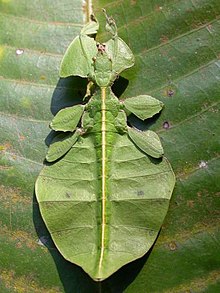
An insect resembling a leaf
Entomology (from
Greek ἔντομος,
entomos, "that which is cut in pieces or engraved/segmented", hence "insect"; and
-λογία,
-logia[1]) is the
scientific study of
insects, a branch of
arthropodology. In the past the term "insect" was more vague, and historically the definition of entomology included the study of terrestrial
animals in other
arthropod groups or other
phyla, such as
arachnids,
myriapods,
earthworms,
land snails, and
slugs. This wider meaning may still be encountered in informal use.
Like several of the other fields that are categorized within
zoology, entomology is a
taxon-based category; any form of scientific study in which there is a focus on insect related inquiries is, by definition, entomology. Entomology therefore includes a cross-section of topics as diverse as
molecular genetics,
behavior,
biomechanics,
biochemistry,
systematics,
physiology,
developmental biology,
ecology,
morphology,
paleontology,
mathematics,
anthropology,
robotics,
agriculture,
nutrition,
forensic science, and more.
At some 1.3 million described species, insects account for more than two-thirds of all known organisms,
[2] date back some 400 million years, and have many kinds of interactions with humans and other forms of life on earth.
History of entomology[edit]

Plate from
Transactions of the Entomological Society, 1848.
William Kirby is widely considered as the father of Entomology. In collaboration with
William Spence he published a definitive entomological encyclopedia,
Introduction to Entomology, regarded as the subject's foundational text. He also helped to found the
Royal Entomological Society in London in 1833, one of the earliest such societies in the world; (earlier antecedents, such as the
Aurelian society date back to the 1740s.)
[4]
Identification of insects[edit]
Most insects can easily be recognized to order such as Hymenoptera (bees, wasps, and ants) or Coleoptera (beetles). However, insects other than
Lepidoptera (
butterflies and
moths) are typically identifiable to genus or species only through the use of
Identification keys and
Monographs. Because the class
Insecta contains a very large number of species (over 330,000
species of
beetles alone) and the characteristics separating them are unfamiliar, and often subtle (or invisible without a
microscope), this is often very difficult even for a specialist. This has led to the development of
automated species identification systems targeted on insects, for example,
Daisy, ABIS, SPIDA and Draw-wing
Insect identification is an increasingly common hobby, with
butterflies and
dragonflies being the most popular.
Entomology in Pest Control[edit]
In 1994 the
Entomological Society of America launched a new
professional certification program for the pest control industry called The Associate Certified Entomologist (ACE). To qualify as a true entomologist an individual would normally require an advanced degree, with most entomologists pursuing their PhD. While not true entomologists in the traditional sense, individuals who attain the ACE certification may be referred to as ACEs, Amateur entomologists, Associate entomologists or –more commonly– Associate-Certified Entomologists.
Taxonomic specialization[edit]

Part of a large
beetle collection
Many entomologists specialize in a single order or even a family of insects, and a number of these subspecialties are given their own informal names, typically (but not always) derived from the scientific name of the group:
Organizations[edit]
Like other scientific specialties, entomologists have a number of local, national, and international organizations. There are also many organizations specializing in specific subareas.
Museums[edit]
Here is a list of selected museums which contain very large insect collections.
- World Museum Liverpool
- The Bugworld Experience, Liverpool
- Natural History Museum, London, United Kingdom
- Naturhistorisches Museum, Vienna, Austria
- Muséum national d'histoire naturelle, Paris, France
- Museum für Naturkunde, Berlin, Germany
- Royal Museum for Central Africa, Brussels, Belgium
- Natural History Museum, Leiden Natural History Museum, Leiden
- Swedish Museum of Natural History, Stockholm, Sweden
- Natural History Museum, St. Petersburg Zoological Collection of the Russian Academy of Science
- Natural History Museum, Geneva [2]
- The Bavarian State Collection of Zoology Zoologische Staatssammlung München
- Natural History Museum, Budapest Hungarian Natural History Museum[3]
- Oxford University Museum of Natural History, Oxford [4]
- Natural History Museum, Oslo, Norway
United States[edit]
- Academy of Natural Sciences, Philadelphia
- American Museum of Natural History, New York City
- Auburn University Museum of Natural History, Auburn, Alabama
- Audubon Insectarium, New Orleans
- Bohart Museum of Entomology, Davis, California
- California Academy of Sciences, San Francisco
- Carnegie Museum of Natural History, Pittsburgh
- Essig Museum, Berkeley, California
- Field Museum of Natural History, Chicago
- Florida Museum of Natural History, University of Florida, Gainesville, Florida
- Illinois Natural History Survey, Champaign, Illinois
- Museum of Comparative Zoology, Cambridge, Massachusetts
- Natural History Museum of Los Angeles County, Los Angeles
- National Museum of Natural History, Washington, D.C.
- NMSU Entomology Plant Pathology and Weed science. "New Mexico State University Arthropod Museum". Retrieved 2013-07-15.
- North Carolina State University Insect Museum, Raleigh, North Carolina
- Peabody Museum of Natural History, New Haven, Connecticut
- Texas A&M University, College Station, Texas
- University of Minnesota, St. Paul campus (UMSP), Minnesota
- University of Kansas Natural History Museum, Lawrence, Kansas
- University of Nebraska State Museum, Lincoln, Nebraska
- University of Missouri Enns Entomology Museum, University of Missouri, Columbia, Missouri
Strong National Museum of Play, Rochester, N.Y.
- Canadian Museum of Nature, Ottawa
- Canadian National Collection of Insects, Arachnids and Nematodes, Ottawa, Ontario
- E.H. Strickland Entomological Museum, University of Alberta, Edmonton, Alberta
- Lyman Entomological Museum, Macdonald Campus of McGill University, Sainte-Anne-de-Bellevue, Quebec
- Montreal Insectarium, Montreal, Quebec
- Royal Alberta Museum, Edmonton, Alberta
- Royal Ontario Museum, Toronto
- Newfoundland Insectarium, Reidville, Newfoundland and Labrador
- University of Guelph Insect Collection, Guelph, Ontario
- Victoria Bug Zoo, Victoria, British Columbia
Entomology in popular culture[edit]
The
Aubrey–Maturin sea novels of
Patrick O'Brian have frequent appearances by Sir Joseph Blaine, a Royal Navy intelligence official who is also an avid entomologist. He recruits Dr. Stephen Maturin, one of the principal characters, as a spy. Their conferences on espionage activities invariably make room for their shared interest in naturalist studies.
There are numerous
science fiction books which have plots based on humans becoming smaller and having to deal with insects at their level. Some examples are
The Insect Warriors by Rex Dean Levie,
Atta by
Francis Rufus Bellamy,
Bug Park by
James P. Hogan,
The Micronauts series by Gordon Williams, and
The Forgotten Planet by
Murray Leinster.
The Forgotten Planets plot is twisted in that the insects are the size of men (or larger) on a planet "seeded" to prepare it for human habitation.
Robert Asprin wrote
The Bug Wars, a novel about war between reptiles and insects on an interplanetary scale.
There are quite a few
films about insects, or at least prominently featuring them. Widespread attitudes of revulsion and fear toward insects are often exploited by
Horror and
Science Fiction films through insect/insect-like monsters (
Them! is a famous early example), or by showing humans transformed into (
The Fly) or attacked by insects. Another more positive type of insect film is
animation with
anthropomorphized insects as characters.
See also[edit]
References[edit]
- Jump up^ Liddell, Henry George and Robert Scott (1980). A Greek-English Lexicon (Abridged Edition). United Kingdom: Oxford University Press. ISBN 0-19-910207-4.
- Jump up^ Chapman, A. D. (2006). Numbers of living species in Australia and the World. Canberra: Australian Biological Resources Study. pp. 60pp. ISBN 978-0-642-56850-2.
- Jump up^ Antonio Saltini, Storia delle scienze agrarie, 4 vols, Bologna 1984-89, ISBN 88-206-2412-5, ISBN 88-206-2413-3, ISBN 88-206-2414-1, ISBN 88-206-2415-X
- Jump up^ Clark, John F.M. (2009). Bugs and the Victorians. Yale University Press. pp. 26–27. ISBN 0300150911.
- Jump up^ Karl von Frisch, Decoding the Language of the Bee, Nobel Lecture, December 12, 1973
Further reading[edit]
- Chiang, H.C. and G. C. Jahn 1996. Entomology in the Cambodia-IRRI-Australia Project. (in Chinese) Chinese Entomol. Soc. Newsltr. (Taiwan) 3: 9-11.
- Davidson, E. 2006. Big Fleas Have Little Fleas: How Discoveries of Invertebrate Diseases Are Advancing Modern Science University of Arizona Press, Tucson, 208 pages, ISBN 0-8165-2544-7.
- Triplehorn, Charles A. and Norman F. Johnson (2005-05-19). Borror and DeLong's Introduction to the Study of Insects, 7th edition, Thomas Brooks/Cole. ISBN 0-03-096835-6. — a classic textbook in North America.
- Grimaldi, D. & Engel, M.S. (2005). Evolution of the Insects. Cambridge University Press. ISBN 0-521-82149-5.
- Capinera, JL (editor). 2008. Encyclopedia of Entomology, 2nd Edition. Springer. ISBN 1-4020-6242-7.
External links[edit]
 | Look up entomology in Wiktionary, the free dictionary. |
“I suppose you are an entomologist?”
“Not quite so ambitious as that, sir. I should like to put my eyes on the individual entitled to that name. No man can be truly called an entomologist, sir; the subject is too vast for any single human intelligence to grasp.”

.jpg)
.png)
.jpg)
.png)
.jpg)
.png)
.jpg)
.jpg)


